Rosanne Cash on career, legacy and new Country Hall of Fame exhibit

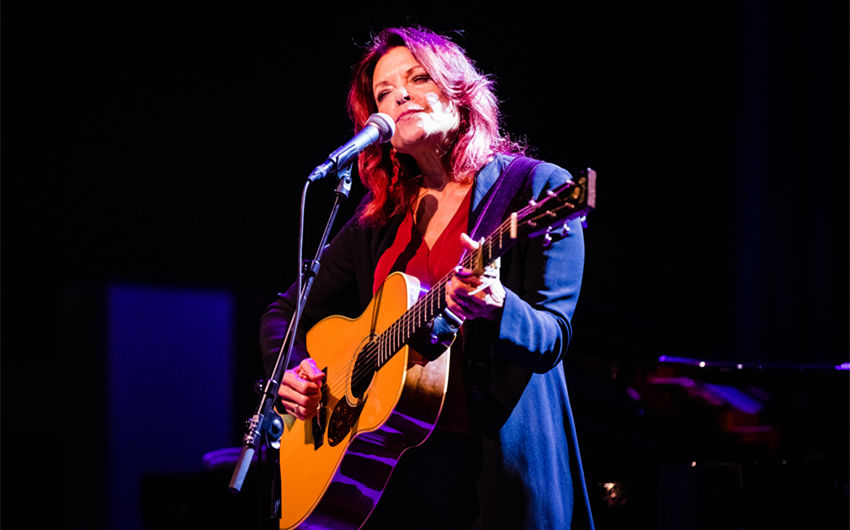
Rosanne Cash’s journey from curiosity-driven teenage rock fandom to a Grammy and Americana Music Association award-winning and 11-time Country Music Association award-nominated musician is highlighted via the Country Music Hall of Fame and Museum’s newest exhibition, “Rosanne Cash: Time Is a Mirror.” It runs through March 2026 and is included with museum admission.
Of course, the 69-year-old performer is also the eldest daughter of Country Music Hall of Famer Johnny Cash and his first wife, Vivian.
One of the exhibition’s successes is celebrating how Rosanne Cash’s acclaim arrived alongside and not wholly impacted by her father’s folkloric and historic American art and life.

It pairs well with Rosanne Cash’s recent achievements, including her just-released 40-song career compilation and the Gibson J-185 model Heritage Cherry Sunburst guitar released as a companion to her father’s J-200 model.
‘Emotional precision’ in songwriting: A Cash family legacy
The best tie that binds Rosanne Cash to the “depth and honesty” of her legendary lineage arrives via contemplating the thoughtful intentionality and raw emotion she has brought to four decades of chart-topping music, starting with 1981’s “Seven Year Ache” and including a series of consecutive No. 1 hits to close the 1980s, including 1987’s “Kings Record Shop” album covers of her father’s “Tennessee Flat Top Box,” “If You Change Your Mind” and “Runaway Train.”
Need a break? Play the USA TODAY Daily Crossword Puzzle.
Speaking to The Tennessean while touring her just-unveiled exhibition, she notes that tying her success to achieving “emotional precision in the context of ambiguity (instead of) pouring out emotion without it being grounded in scenes and people” is best.
The exhibition’s lead curator is the Hall of Fame and Museum’s Writer-Editor, R.J. Smith. He offers a sense of how Rosanne operates with her father as one of many contemporary influences rather than a shadowing legacy.
He adds that her uniquely “connective” ability to convey how she perpetually reckons with the power of her influences impacts her progressive-minded creativity is also key.

He settles upon a sturdy but weathered writing desk that Rosanne Cash inherited from her father after his 2003 passing to highlight how much he respected his daughter’s work.
“It’s a humble, timeless altar to (the creativity they shared),” adds Curtis.
Viewing her exhibition
Rosanne Cash is taken aback by having so many core pieces of her life now showcased as potentially broader influences for the million yearly patrons visiting the Country Music Hall of Fame and Museum.
There’s everything from a “Cradle Club” certificate saved from her first flight at nine months old to a suede jacket that her father had hand-crafted for her during a trip to New York City. She stares at another dress she wore onstage in 1988 at the Roxy in Los Angeles and immediately recalls the concert’s newspaper review as quickly as Rosanne Cash laughs about a chord she missed while playing. Another gown recalls 2015, a year in which she was chosen as both an Artist In Residence at the Country Music Hall of Fame and a Perspective Series artist at Carnegie Hall.
Of note, it’s worth pausing, like she does, when mentioning the latter year because it marked an era in her life where she achieved what could be defined as her life’s eventual goal: creative reach and relevancy as a vital catalyst in numerous multimedia realms.
In 2014, her song “A Feather’s Not A Bird” won a Grammy for Best American Roots Performance while she was also nominated for Artist of the Year at the Americana Music Honors & Awards. These all arrived a half-decade after “Composed,” her book of memoirs, was published.

Rosanne Cash’s perpetually inspirational creative process
Developing her art in various arenas, in a crucible built in reverence of the past, present and future that perpetually surrounds her, allows for the influence of Joni Mitchell’s songwriting to resonate against her father’s iconic work. Then, hearing Crosby, Stills, Nash and Young on the “Woodstock” soundtrack plays against being taught the guitar by teachers, including rock progenitor Carl Perkins and her step-matriarch (and country music’s matriarch as well) Mother Maybelle Carter.
Rosanne Cash’s childhood influences created a perpetual relationship she’s had with “legitimately, poetically and seriously” writing about her inner life for public consumption. Dive deeper into how she’s always returned to her fundamental roots in conversation with her art and life and note how, by 1991, she was tired of the “suffocating” grind of the Nashville machine against multiple facets of her existence, so she relocated to New York City.
That move spawned her critically acclaimed classic album “The Wheel,” produced by John Leventhal, the man to whom she eventually married after divorcing performer Rodney Crowell in 1992.
Evolving her life and work to grow into what she notes Ray Charles calling “her life showing up in her voice at 50,” found Rosanne Cash at 40 in 1995, at a creative inflection point, thrusting herself into all facets of creativity via painting, singing and writing.
Because she’s such a tireless pure artist, every decade since, she’s reached a place where any two of the three: crafting, language, or sound, uncomfortably overflows its metaphorical cup that resides inside her.
“Moving in a different direction than the one that’s blocked creates an ‘a-ha’ moment that (continues to motivate you),” Rosanne Cash says about how she retains her vitality and refreshes her inspiration.

‘Some of my art is still alive’
Along her intriguingly creative life journey, Rosanne Cash has developed a “thick skin and open heart” while learning “who she was and what she was going to do.”
Nearing 70 and what she admits could be the end of her life, her thoughts turn to her catalog and how its monumental volume impacts the same crucible borne of the past, present and future in which her career was created.
A brief statement offers a broader sense of Rosanne Cash’s awareness of how her new exhibition highlights her fully developed legacy.
“Some of my art (though it impacts me differently now) is still alive.”
link