Mentor support and postdoctoral sustainable careers: evidence from China
COR theory
COR theory describes how individuals manage stress, emphasizing their efforts to acquire, conserve, protect, and develop valued resources during interactions with their environment (Hobfoll 1989). In stressful situations, individuals use existing resources to acquire new ones, thereby reducing overall resource loss. Simultaneously, they proactively build and maintain their current reserves to prepare for potential future resource depletion (Hobfoll et al. 2018). COR theory identifies two key pathways: when individuals experience stress and fail to effectively prevent resource depletion or secure timely resource compensation, they may experience “loss spirals”, where resource loss accelerates over time (Hobfoll 1989; Demerouti et al. 2004). Conversely, resource-rich individuals can leverage their existing resources to create a “compound interest effect”, triggering “gain spirals”—an upward trajectory of resource accumulation (Hobfoll 2001; Halbesleben and Wheeler 2015).
Grounded in the concept of resources, COR theory highlights that resources function as interconnected and mutually reinforcing elements, much like a “caravan” (Hobfoll et al. 2018). These resources can be broadly categorized into contextual resources (e.g., material resources, social support) and personal resources (e.g., self-efficacy, identity-related psychological resources) (Ten Brummelhuis and Bakker 2012; Liu et al. 2023). Existing research shows that “gain spirals” involve a chain process in which job resources enhance work engagement, which in turn fosters personal initiative, ultimately contributing to the acquisition of additional job resources (Hakanen et al. 2011; Bakker and Demerouti 2024). However, research remains limited in exploring how cross-level resources (e.g., external to personal) are sequentially acquired and transformed to produce career-related outcomes (Halbesleben et al. 2014). Addressing this research gap could provide critical insights into the mechanisms through which contextual resources are internalized and conserved, particularly during resource-scarce conditions.
To advance this understanding, this study proposes a chain mediation model based on the COR framework (mentor support → work engagement → academic career identity → sustainable careers). This model explores how external resources (mentor support) are transformed into enduring psychological resources (academic career identity), ultimately promoting the sustainability of postdoctoral careers.
In China’s current resource-constrained and highly competitive academic environment (Xu and Shen 2024), mentor support has become a vital external resource for postdocs (Chen and Zhang 2022). Mentor support plays a dual role: intrinsically, it motivates postdocs and facilitates their academic development (Wang and Deng 2012; Van Benthem et al. 2020); extrinsically, it helps postdocs achieve career objectives, such as gaining recognition or career mobility (Åkerlind 2009). This positive orientation aligns with the three key dimensions of sustainable careers: productivity, happiness, and health (De Vos et al. 2020).
From a COR perspective, mentor support functions as a crucial external resource that mitigates resource depletion by providing both social and professional assistance (Li et al. 2024). This support enhances postdocs’ work engagement, which manifests as increased vigor, dedication, and absorption in their academic pursuits (Ali Abadi et al. 2023). Through work engagement, postdocs can focus on meaningful academic activities and transform external resources—such as mentor guidance, employment opportunities, and professional networks—into personal assets that strengthen their academic career identity (Zhang and Guo 2023). This academic career identity, as an essential psychological resource, reinforces postdocs’ connection to their career goals (Gao and Yang 2022), aligning their efforts with long-term objectives. This alignment enables postdocs to navigate the complexities of competitive academic environments more effectively. By transforming external support into sustainable personal and career advantages (Lee et al. 2016), postdocs can enhance their ability to achieve sustainable careers characterized by productivity, happiness, and health.
Mentor support and postdoctoral employability
The widely recognized concept of employability is defined as an employee’s ability to maintain their current job (internal employability) or secure a desired job (external employability) (Rothwell and Arnold 2007). In the context of postdocs, employability refers to their ability to effectively fulfill current postdoctoral duties (internal employability) and pursue targeted research positions or career advancement after leaving the station (external). In China, the establishment of postdoctoral positions was initially intended to recruit exceptional young PhDs with a strong academic orientation and an interest in research, facilitating their engagement in innovative projects and fostering the development of high-level professional talent (Wang and Ren 2016). The evaluation of postdocs’ employability is primarily based on academic and transferable abilities (Wang et al. 2020; Peng 2020). Academic abilities include skills in identifying research problems and effectively communicating and collaborating with fellow scholars, while transferable abilities encompass competencies such as securing funding and establishing academic social networks (Liang and Li 2022).
Although definitions of postdoctoral work vary across different countries and regions, common characteristics can be summarized as follows: “Individuals with a doctoral degree or equivalent qualifications, guided by senior professors or authoritative scholars, engage in temporary or fixed-term research or academic training to develop the professional skills and independent research capabilities required for future careers” (Liu and Yuan 2016). Compared to other academic professions, postdoctoral work is distinctive due to its temporary and transitional nature. While postdocs develop increasing research independence, they remain embedded within institutional structures and continue to rely on mentors for career guidance, networking, and research opportunities.
Mentor support broadly refers to the range of supportive behaviors that mentors provide to their mentees during their learning and personal development (Crisp and Cruz 2009). The role of mentors during the postdoctoral phase differs significantly from that during graduate student training (e.g., master’s or doctoral programs). Unlike graduate students, who primarily receive structured guidance and supervision from advisors, postdoctoral researchers are expected to demonstrate greater independence in conducting scientific research. Consequently, their relationship with mentors evolves into a more collaborative dynamic (Zhang 2013), where mentorship extends beyond direct instruction to include research collaboration, career guidance, and professional networking (Wu and Zhao 2021). Studies have shown that mentor support significantly contributes to postdocs’ academic productivity (Wang and Deng 2012), academic success (Liénard et al. 2018), scientific innovation, and original scientific discoveries (Ding, 2019), as well as their overall job satisfaction (Jiang and Guo 2022), career aspirations (Liu and Xie 2022), and career prospects (Chen and Zhang 2022). Mentors provide essential guidance and assistance to postdocs in professional knowledge and competencies, facilitating the growth of postdocs’ research capacity and outputs, building a foundation of academic competence, and helping them meet their career expectations (Jaeger and Dinin 2018). Furthermore, mentors can provide access to broader academic networks and career opportunities, further expanding their developmental perspectives (Nowell et al. 2020). In summary, the following hypothesis is proposed:
Hypothesis 1a: Mentor support is positively associated with postdoctoral employability.
Mentor support and postdoctoral subjective career success
In the concept of sustainable careers, happiness reflects an individual’s subjective perception of career success and satisfaction. This perception can be assessed through subjective career success (De Vos et al. 2020), which involves the dynamic alignment of professional and personal values, career goals, work-life balance, and personal growth needs (Sheldon et al. 2002).
The postdoctoral period is a crucial transitional stage (Lin and Chiu 2016), marking the shift from student status to independent researcher status (Gao and Yang 2022). For young scholars, this stage represents both an accumulation process of human capital and an investment process of signal capital (Zhang and Liu 2019). It provides an effective way to secure desired lifelong academic career opportunities (Sauermann and Roach 2016). Whether postdocs make significant progress in their professional development and gain recognition from themselves and their peers profoundly impacts their future career trajectories (Hudson et al. 2018). Therefore, personal growth and development are crucial needs during the postdoctoral period, and the extent to which these needs are satisfied constitutes an important component of subjective career success.
Furthermore, postdocs are usually at an age where marriage and childbearing are common, with nearly half of the postdocs in our survey sample being married. Work-life conflict is strongly associated with low job satisfaction and burnout in academic research settings (Fox et al. 2011), while work-life balance is often viewed as a positive buffer against research-related stress (Bozeman and Gaughan 2011). In summary, this paper measures postdoctoral subjective career success from two perspectives: work-life balance and personal growth satisfaction. Work-life balance assesses the degree to which work and personal life are mutually exclusive and how effectively individuals manage the two. Personal growth satisfaction focuses on the development and expansion of professional skills and knowledge, the recognition of research outcomes, and the perceived value of these outcomes.
According to the job demands-resources (JD-R) model, job resources buffer the stress and attrition caused by job demands (Bakker et al. 2005; Xanthopoulou et al. 2007), while simultaneously motivating individuals, ultimately promoting job performance and job satisfaction. Mentor support, as a critical job resource, can help and support postdocs in various vital aspects, such as sharing subject-specific expertise, expanding academic networks, and recommending career development opportunities (Guidetti et al. 2022). These supports help alleviate career stress, meet work requirements, and reduce feelings of isolation, enhancing postdocs’ sense of control over their work and life (Vekkaila et al. 2018). They also improve subjective well-being and work enthusiasm, enabling postdocs to engage with their academic work with a more optimistic attitude (Gloria and Steinhardt 2017), which in turn enhances their subjective career success. From the perspective of COR theory, if the multiple pressures faced by postdocs are not addressed in a timely and appropriate manner, their research progress may stagnate, hindering academic development and leading to increased psychological stress (Hobfoll 2001). The acquisition of mentor support as a resource can trigger a spiral increase in other positive resources, thereby enhancing overall well-being. In summary, the following hypothesis is proposed:
Hypothesis 1b: Mentor support is positively associated with postdoctoral subjective career success.
Mentor support and postdoctoral mental health
Postdocs face numerous challenges in their academic careers, including the instability of the academic job market, demanding job application requirements, and difficulties in maintaining work-life balance. These challenges often lead to heightened levels of anxiety, stress, and depression, negatively impacting their psychological health (Taris et al. 2010; Hayter and Parker 2019). This mental condition hinders their ability to fully utilize research expertise, increases workload, amplifies perceived work stress, and directly undermines work efficiency, ultimately jeopardizing their long-term career development (Zhou et al. 2022). Mental health is increasingly recognized as a crucial factor for achieving academic career success (Chen and Lalovic 2019). Psychological capital, as a positively oriented, renewable, and non-scarce essential individual resource, represents an evolving state of positive psychological well-being (Luthans and Youssef 2004). Individuals with high psychological capital tend to show a more optimistic, positive, and healthy mental state in both their work and personal lives.
Mentor support serves as a crucial psychological and structural resource that alleviates postdoctoral work stress (Bakker et al. 2014), enabling postdocs to conduct research more efficiently, reduce negative emotions, and develop positive psychological capital (Caesens et al. 2020). First, mentor support provides emotional buffering, reduces career-related anxiety, and fosters psychological well-being. Given the competitive and uncertain nature of postdoctoral careers, mentors help postdocs navigate professional insecurities and maintain emotional stability (Skakni et al. 2019). Strong mentor-postdoc relationships enhance mental well-being by providing constructive feedback and psychological safety (van der Weijden and Teelken 2023). Regular interactions with mentors strengthen resilience, enabling postdocs to cope with academic pressures and sustain engagement (Xiao 2024; Van Benthem et al. 2020). Second, mentor support reinforces intrinsic motivation and strengthens professional identity. Personalized guidance helps postdocs develop research strategies, gain a sense of control over their work, and enhance self-efficacy and motivation (Dorenkamp and Weiß 2018). Encouragement and positive feedback from mentors boost confidence and career commitment, reducing psychological distress and enhancing job satisfaction (van der Weijden and Teelken 2023; Gloria and Steinhardt 2017). Third, mentor support facilitates professional integration within academic networks. A nurturing academic ecosystem, characterized by mentorship and institutional support, ensures smoother adaptation to independent research (Chen et al. 2015). Mentors play a pivotal role in connecting postdocs with academic networks, facilitating collaborations, and providing career guidance, which alleviates stress related to professional isolation. Furthermore, mentors act as psychological stabilizers, supporting postdocs in managing long-term academic pressures and sustaining research engagement (Chen 2023).
In line with COR theory, individuals with abundant resources are more inclined to acquire additional resources (Hobfoll 2002). When postdocs receive adequate mentor support, they tend to accumulate and sustain internal psychological capital, which promotes continuous personal and professional development. In summary, the following hypothesis is proposed:
Hypothesis 1c: Mentor support is positively associated with postdoctoral mental health.
The mediating role of work engagement
In complete contrast to the concept of burnout, work engagement is defined as a positive, fulfilling work-related mind state characterized by vigor (high energy and resilience), dedication (a sense of meaning, enthusiasm, and pride in one’s work), and absorption (being so absorbed in work that time seems to pass unnoticed) (Schaufeli and Bakker 2010; Bakker et al. 2012). Schaufeli and Bakker (2004) incorporated work engagement into the JD-R model, proposing that job resources have inherent motivational properties that can motivate employees to increase work engagement (Mauno et al. 2007; Xanthopoulou et al. 2009), which in turn produces positive outcomes. Research has shown that adequate resources are a vital prerequisite for employees to actively engage in their work; for example, workplace support can significantly enhance work engagement (Lin et al. 2020). In the context of postdoctoral work, mentor support has also been shown to promote positive emotions, which in turn motivate postdocs to become more engaged in their research (Gloria and Steinhardt 2017). Firstly, mentor support provides the necessary resources to sustain postdocs’ work engagement. High levels of mentor support offer practical assistance and emotional backing, such as guidance on project or grant applications, help with expanding academic networks, and encouragement for maintaining work-life balance. These forms of support alleviate the work stress of postdocs, prevent resource depletion, and enable them to focus on their work without distraction. Secondly, mentor support serves as a key motivational driver for active work engagement. During the postdoctoral phase, mentor support helps postdocs accumulate essential resources for career development, such as social networks, knowledge, and experience. Following the principle of reciprocity, postdocs may feel motivated to reciprocate this support by engaging more deeply in their research activities (Cropanzano and Mitchell 2005).
Academic engagement is a significant predictor of academic achievement and performance (Galla et al. 2014; Saklofske et al. 2012; Salanova et al. 2010). For instance, Zhao and Wu (2022) demonstrated that postdocs’ engagement in academic research ensures a positive trajectory for their academic career development. Numerous studies have shown that work engagement significantly and positively predicts task and situational performance (Christian et al. 2011). Individuals with high levels of work engagement experience more extraordinary positive emotions, which enhance cognitive functioning and further expand their available resources (Fredrickson 2001). This process creates an upward spiral of resources, often facilitated by mentor support. Mental health has also been found to be positively correlated with work engagement. Dedicated individuals face higher job demands than those experiencing burnout, yet exhibit better mental health (Schaufeli et al. 2008). Through continuous engagement, postdocs “reap what they sow”, achieving noticeable improvements in their research capabilities and outputs. These inprovements, in turn, supports the ongoing development of essential psychological, physiological, and professional resources, ultimately fostering the development of their sustainable careers (Zhou et al. 2022). In summary, we argue that work engagement can play a bridging transmission role in the positive impact of mentor support on postdoctoral sustainable careers, and the following hypotheses are proposed:
Hypothesis 2a: Work engagement mediates the relationship between mentor support and postdoctoral employability.
Hypothesis 2b: Work engagement mediates the relationship between mentor support and postdoctoral subjective career success.
Hypothesis 2c: Work engagement mediates the relationship between mentor support and postdoctoral mental health.
The mediating role of academic career identity
Academic career identity refers to a positive attitude and strong commitment toward an academic career. It is widely acknowledged that choosing an academic career signifies a robust academic career identity (Wu and Zhao 2021). During the postdoctoral period, postdocs’ personal and professional trajectories are profoundly influenced by their experienced mentors, whose support significantly influences career decisions and the development of academic identity (Lambert et al. 2025).
Numerous studies highlight the importance of mentors in postdocs’ professional growth. For example, a survey on scientific and technological talent found that nearly all interviewees identified “having a good mentor” as the most influential factor in their professional development” (Su and Zhou 2022). Furthermore, research has shown that postdocs who benefit from effective mentorship are more likely to experience positive career outcomes and maintain a firm intention to pursue academic careers (Chou et al. 2022). Strong mentorship has been confirmed as a significant factor influencing postdocs’ decision to remain in or leave the academic research pathway (Afonja et al. 2021; Lambert et al. 2020; McConnell et al. 2018). The collaborative communication between mentors and postdocs fosters knowledge generation and reflection, helping postdocs clarify their career paths, build confidence in academia, and ultimately commit to long-term academic careers (Qureshi et al. 2024). Postdocs who receive substantive career guidance from their mentors, rather than being viewed as inexpensive labor, are more likely to develop a stronger sense of academic career identity and higher job satisfaction (Liang and Li 2022).
One of the most significant ways mentors support postdocs is by fostering the development of academic self-efficacy (Yang et al. 2024). Academic self-efficacy is a key intrinsic motivator for forming career identity and clarifying career goals (Ireland and Lent 2018). The demanding and often isolating “lone warrior” work model can easily lead to anxiety and burnout (Zhu 2024; Ysseldyk et al. 2019). In this context, mentor support enhances postdocs’ academic capabilities and productivity, thereby strengthening their confidence in managing academic pressures and challenges (Zheng et al. 2024; McConnell et al. 2018). Another crucial role of mentors is their assistance in helping postdocs build academic networks and gain access to critical career development opportunities (Zhou and Yang 2017). This support enhances their academic competence and competitiveness, opening up broader career possibilities through accumulated academic networking resources (Wu et al. 2024). Finally, mentors often serve as professional role models or “benchmarks” for postdocs (Vinales 2015). The academic achievements and professional reputation of mentors serve as powerful sources of inspiration, motivating postdocs to pursue similar academic careers (Rida et al. 2023; Ware and Stein 2013). The professionalism, academic rigor, and passion for knowledge demonstrated by mentors reinforce postdocs’ appreciation for academic research, deepen their academic career sentiment, and encourage them to commit to the academic path (Qureshi et al. 2024).
Postdocs with a strong academic career identity demonstrate positive attitudes toward academic work, such as recognizing, acknowledging, and accepting its value (Holland et al. 1993). They exhibit a stronger sense of work flourishing and career well-being (Liu et al. 2024). They view academia as their primary career direction and ultimate goal. This positive orientation not only fosters job satisfaction but also enhances perceived employability and promotes professional development (Zhang et al. 2023; Gao et al. 2017). In summary, we argue that academic career identity can play a bridging transmission role in the positive impact of mentor support on postdoctoral sustainable careers, and the following hypotheses are proposed:
Hypothesis 3a: Academic career identity mediates the relationship between mentor support and postdoctoral employability.
Hypothesis 3b: Academic career identity mediates the relationship between mentor support and postdoctoral subjective career success.
Hypothesis 3c: Academic career identity mediates the relationship between mentor support and postdoctoral mental health.
The chain mediating role of work engagement and academic career identity
Work engagement can be viewed as a process of resource accumulation, mediating the longitudinal impact of initial resources on subsequent resources (Weigl et al. 2010). This mechanism aligns with the concept of “gain spirals” in COR theory, where resources generate additional resources through a “compound interest effect” (Hobfoll 2002). For postdocs, a high level of work engagement facilitates the acquisition of multiple resources, including intellectual capital, social capital, and academic influence (Perkmann et al. 2021). Firstly, postdocs gradually accumulate profound professional knowledge and experimental skills, accumulating valuable intellectual capital. High-quality publications and in-depth research enable them to progressively shape their academic influence, contributing to long-term career development within academia (Song and Yang 2023). Secondly, postdocs gain substantial research experience and strategic insights through participating in diverse research projects. This involvement fosters innovative thinking and enhances research capabilities. At the same time, the academic exchanges and collaborations they establish with experts and scholars across various fields further expand their academic networks and broaden their intellectual horizons, thus accumulating valuable social capital (Chen et al. 2015).
These accumulated resources enhance postdocs’ sense of academic meaningfulness, which is crucial for shaping their career identity (Hirschi 2012). Furthermore, according to the principles of COR theory, when postdocs possess multiple resources, they are more likely to take proactive measures to protect these resources and avoid their depletion. The considerable sunk costs associated with academic careers may strengthen postdocs’ resolve to remain in academia (Browning et al. 2017). A sustainable career highlights individual initiative, the pursuit of self-worth, and meaningfulness, referring to a career experience that balances health, happiness, and productivity. It is an experience that can withstand external uncertainties and, over time, achieve resource accumulation and career development (Van der Heijden and De Vos 2015; De Vos et al. 2020). In this context, work engagement and academic career identity correspond to the concept of “individual proactivity” and “individual sense of meaningfulness”. Work engagement acts as the mechanism through which external resources (mentor support) are internalized into personal resources (enhanced academic career identity). This internalization strengthens postdocs’ connection to their career goals, contributing to long-term career sustainability. The theoretical framework linking work engagement and career identity has been validated. For instance, work engagement and career identity have been shown to act as chain mediators in the influence of perceived social support on vocational calling among Chinese special education teachers (Zhang and Guo 2023). In summary, the following hypotheses are proposed:
Hypothesis 4a: Work engagement and academic career identity serve as chain mediators in the relationship between mentor support and postdoctoral employability.
Hypothesis 4b: Work engagement and academic career identity serve as chain mediators in the relationship between mentor support and postdoctoral subjective career success.
Hypothesis 4c: Work engagement and academic career identity serve as chain mediators in the relationship between mentor support and postdoctoral mental health.
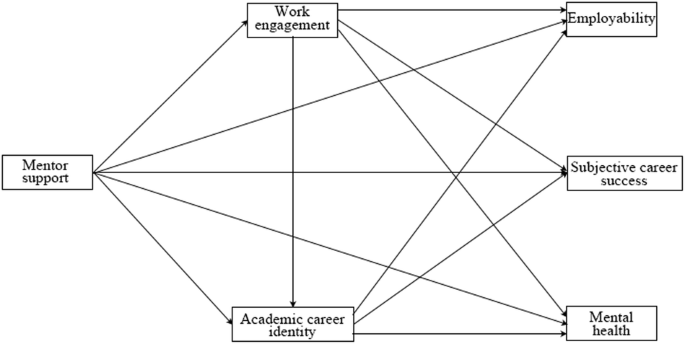
In summary, this study constructed a theoretical model of the influence of mentor support on postdoctoral sustainable careers, as illustrated in Fig. 1.
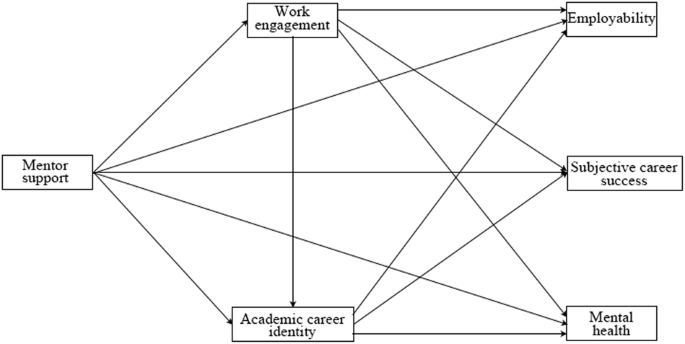
Mechanisms of mentor support on postdoctoral sustainable careers.
link