


The Delta Career Advancement Center has come a long way since its humble beginning in a donated modular building. Over the course of 22 years the center has paved the way for high school graduates to enter the trades fields.
It all began with a vision of a local high school construction trades program. Secondary schools across the nation had shifted their focus from construction and technological fields to college-based education. Trades classes were being cut and, in some instances, no longer offered in secondary schools. This was leading to a shortage of skilled, trained, construction and trades workers. The Delta/Greely School District, under then Superintendent Dan Beck, saw this and brainstormed how to help fill that niche. They realized it would be a big undertaking and require substantial funding.
So, in 2003 the Partners for Progress in Delta, Inc. was formed. It included the Delta/Greely School District, Delta High School, the University of Alaska Fairbanks Community Technical College, Cooperative Extension, and the Alaska Works Partnership, Inc. This educational consortium sought to close the training gap and began to plan and fundraise for the future center.
The timing coincided with the realignment of Fort Greely and its new mission as the site of the Ground-based Midcourse Missile Defense. The Department of Defense completed an Economic Adjustment plan in 2002 regarding the change in Fort Greely’s mission. The end result of the study was the release of impact funds to the Delta Junction area.
“I was with the City Council at the time,” explained Mary Leith, current board president of Partners for Progress in Delta. “The Council was looking for someone to represent the city and work with the Partners for Progress. This whole idea was pretty much a new concept for this town and a couple still had their druthers, but I volunteered, we all rolled up our sleeves and got to work.”
“We started out by applying for a portion of those funds,” explained Gary Hall, construction trade coordinator and instructor. “The City Council helped us obtain grants and Karen Cedzo, who worked with the University System, came on board as our financial administrator. Through Cedzo we received help from the Denali Commission and other large investors.”
But it wasn’t only major investors who saw potential in the Center. News in a small-town travels fast and it wasn’t long before the word on the street was that a trades center was in the works.
“I made a stop at the IGA one day during the early stages of the fund-raising process,” Hall recalled. “Bill Seitz, who by then had sold his hardware store, called me over to his pickup. He had on that perpetual hard hat of his and in his gruff voice said, ‘I understand you’re starting a trade center and I wanna help with that’. Right then and there, he pulled out his checkbook and on the hood of his truck wrote out a $5,000 check. The Rasmussen Foundation had already agreed to match any personal donations, so that $5,000 turned into $10,000.”
It wasn’t before long the idea was catching on and the money trickled in,” continued Hall. “We received checks for $25, $50, all which were matched by the Foundation. People’s willingness to contribute showed me we were on the right path.”
“Another time when Karen and I were literally beating the streets, we walked into the IGA, up to Ed Larson, told him our story and asked for a contribution,” he continued. “Right there, Ed wrote out a check to us. All in all, we came up with $250,000 in private monies thanks to the Rasmussen matching fund.”
Meanwhile an Anchorage based construction company finished up a job on Greely and was getting ready to pull out.
“They called me up and said hey, we have this modular unit that needs to move and we want to donate it to you,” Hall said. “This was in the fall of 2002. So along with Dan Beck we went out there, took a look and said we’ll take it.”
Accepting a building is one thing, moving a 28-foot structure down the highway is another. Hall got hold of Ed Carnes who he knew had the ways and means to pull off the move.
“This was before too much activity was taking place on Greely, so traffic was already pretty sparse,” explained Hall. “I got the necessary permits together and went to talk to the head of Allen Army Airfield. I told him I have this building that needs to be moved to Old Post and I’m going to need part of your airfield. We sat down, figured out a day and time. Mind you, this was in December, a cold and snowy December. We got everything set up, moved that 28-foot building to Old Post and Ed Carnes loaded it up in one piece. We chose that early December Sunday morning as we knew traffic would be at a minimum. Carnes got that building downtown and set it up in one piece. When Christmas break was over, I held my first construction trades class in that building.”
Fourteen students showed up for that class in January of 2003, and soon found themselves at work.
“The building needed modifications and fixing up, so the students got their first taste of construction,” smiled Hall. “And that modular went on to become the headquarters for the program.”
“Then what I like to call Phase One started in 2003,” explained Hall.” Phase One saw the shell go up. No concrete slab yet but we had a building. I worked with the contractors to get the students involved so they would experience real world construction. By 2004 that heated shell was up. No concrete slab yet but we had a building. The fire marshal signed off on it and we opened its doors.”
But tools were in short supply and the student interest was increasing. Mike Andrews with Alaska Works Partnership contacted Hall and told him to put together a tool list.
“I went up to Alaska Industrial Hardware and wrote out a list for $14,000 worth of tools,” said Hall. “I passed that list to Mike and he started laughing. ‘What are you doing? Starting up a construction company?’ I told him you are exactly right. That is what those students are learning. He sent me that check and those tools were the basis for our program. We still use them to this day.”
Phase Two started in 2004 and the building, complete with a concrete floor, was finished in 2005. The 9,600 square foot building now housed 7,000 square feet of workshop. An official ribbon cutting ceremony was held in 2005, a year after the Construction Trades Program was already in full swing
Aside from the high school classes multiple evening and weekend classes were offered to the community.
The idea came about to expand the program offering more classes and training. The schedules were running into conflicts with multiple users wanting to use the space.
“The workshop area is set aside for high school students during daytime,” said Hall. “This does place some limits on potential classes. For example, we recently had a week-long eight hour a day course that we had to hold during spring break. And some instructors can only teach at certain times.”
Plans were previously drawn up for a stand-alone addition that included a walkway between the two buildings. The area was surveyed, funds applied for, but then the state economy bottomed out.
“Oil prices dropped, the state economy took a big dip, then COVID hit,” explained Leith. “That changed everything. We ended up with a design we could no longer afford. The decision was made to scrap the stand-alone idea and instead build an extension off the north side of the building.”
With what funding they did have, a 160 x 26-foot pad was poured, and anchor bolts put in place.
“I once again call that our Phase One,” said Hall. “In addition to the slab, the boiler system was upgraded to handle the new addition.”
The state legislature later came through with a $1.365 million capital grant to put up an occupiable, heated shell.
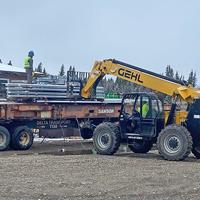
Heritage General Construction and M2C1 Construction and Engineering worked together and submitted a joint venture bid and have already been working on site.
“Steel is already here, and so is the building package,” Hall said. “Construction will be starting this week.”
The addition will provide an additional 2,000 feet of shop space. It includes bathrooms, a conference room, and a future medical training classroom.
“Plans for the future, or Phase Three, call for a garage to house that ambulance you see out there,” explained Hall. The ambulance has a blown engine, but the students can use it to learn the workings of an ambulance and get used to maneuvering in the confined space. We are looking for money, but as we all know the funding process has changed.”
“We are a career technical training center,” explained Hall. “This is not just for high school students but for adults. The Center still has after hours and weekend classes open to the community.”
Hall noted the building is also designated as a community emergency center. The stand-alone building houses its own generator that automatically kicks on when and if there is a power outage. It does a weekly self-analysis and startup to ensure it is in working order.
“Our program and its successes has captured attention not only statewide but nationwide,” commented Hall. “Nothing gives me greater pleasure than students stopping by saying hey, I got accepted into the IBEW, I’m a journeyman, I’m now a member of the Operators, and am working at Fort Knox, on the Slope.”
“And not everyone who is part of the program follows through in the trades,” commented Leith. “But they are learning life skills. They are learning work ethic that transfer to any job or career. I myself took the women’s power tool class and actually now understand the tools and would be comfortable using them if needed.”
Up to 50 high school students attend one of the five daily held classes at the Center.
“What is a favorite among the students? Welding,” said Hall.
The Center offers multiple daily and weekend classes to the public.
Classes are advertised online, in the Delta Wind, and throughout the community.
The new 4,100 square foot addition is expected to be open for the 2025-2026 school year.
link